Nvidia’s $1 Trillion Revenue Target by 2027: Behind the AI Factory Transformation
Nvidia’s trillion-dollar ambition is not a forecast of $1 trillion in revenue during the single year 2027. It is a statement about the cumulative business opportunity associated with Blackwell and Vera Rubin through that period—and about the scale of infrastructure customers may need as AI moves into continuous operation.
At GTC on March 16, 2026, Jensen Huang said he could see at least $1 trillion through 2027, extending an earlier outlook of roughly $500 billion through 2026. Reporting described the figure variously as expected sales, demand, and purchase orders. It should not be rewritten as a fully recognized revenue total or an independently audited, non-cancelable backlog.
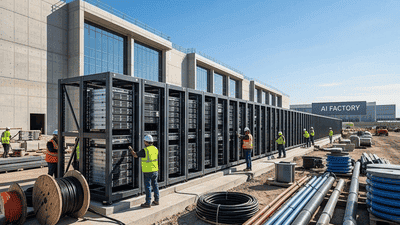
The bigger story is industrialization. Nvidia wants AI infrastructure to operate like a production system: taking in data and electricity, performing computation, and delivering useful outputs at an economically attractive rate.
The Trillion-Dollar Figure Needs a Defined Scope
The forecast concerns Blackwell and Rubin, not every Nvidia product or every dollar spent on AI infrastructure.
Reuters reported that the estimate excluded several additional categories, including CPUs, networking products, Groq-derived technology, and Rubin Ultra. It also excluded the China-specific chip sales discussed alongside it.
That makes the figure both substantial and specific.
It should not be compared casually with total data-center construction spending, cloud operators’ entire capital budgets, or one fiscal year of Nvidia revenue. Those measures cover different activities and time periods.
Demand, Orders, and Revenue Are Different Milestones

A customer’s expected requirement is demand. A commercial commitment can become an order under particular terms. Revenue is recognized when the applicable accounting requirements are satisfied.
Those stages can be separated by manufacturing, delivery, and customer schedules.
A large pipeline therefore provides visibility without establishing a completed outcome.
For investors, the important questions are how much demand becomes firm business, when the hardware ships, and whether customer deployment plans remain economically supported.
What Nvidia Means by an AI Factory
An AI factory is infrastructure organized to produce AI outputs at scale.
It includes accelerators, CPUs, memory, networking, storage, software, power, and cooling.
The factory analogy emphasizes repeated operation rather than one extraordinary training experiment.
That shift changes the commercial conversation. Buyers evaluate throughput, reliability, utilization, and cost per useful result—alongside the ability to develop and train models.
The Output Is More Than Tokens

Language-model services often measure output in tokens, but AI infrastructure also supports images, audio, video, recommendations, scientific workloads, and other results.
Even in text-based systems, token count is not equivalent to value.
A correct answer can be worth more than a much longer response that requires correction or retrying.
For an AI factory, the useful economic measure is acceptable work delivered. Tokens provide a convenient throughput unit, but should not replace quality and application outcomes.
Inference Creates a Recurring Infrastructure Requirement
Training produces or updates a model. Inference uses that model to respond to requests or perform tasks.
A successful service can create continuous demand long after its initial development.
That is why inference matters to Nvidia’s expansion story: deployment turns computing into an ongoing operating requirement.
However, the relationship is not automatic. More users do not necessarily produce proportional hardware demand, because model efficiency, serving software, workload mix, and pricing also change.
Agentic AI Can Increase Work per Request

An agent may generate a plan, invoke tools, examine results, and continue through several steps before completing a task.
That can require more model execution than a single question-and-answer exchange.
It also makes latency important because delays accumulate across sequential actions.
For Nvidia, this creates demand for both aggregate throughput and responsive execution. For customers, the additional computation must still produce enough useful value to justify its cost.
Blackwell and Rubin Serve Different Parts of the Expansion
The trillion-dollar outlook spans more than one architecture generation.
Blackwell provides an established deployment foundation, while Rubin represents the next stage in Nvidia’s platform development.
Customers can expand current capacity while preparing subsequent systems.
That overlapping transition is commercially important. The forecast depends on continuity between generations, not one isolated product launch or a sudden replacement of every existing accelerator.
The Product Is Increasingly a Coordinated System
A high-performance GPU depends on memory, interconnects, CPUs, and software to remain productive.
At rack scale, power distribution, cooling, physical layout, and maintenance become equally relevant.
Nvidia’s strategy is to coordinate those elements as a platform rather than leave every customer to assemble them independently.
This can reduce integration friction, but also increases the importance of manufacturing partners and complete-system readiness. A strong chip specification alone cannot deliver the factory.
Memory Can Limit the Value of More Compute
AI workloads need capacity for model weights and working data, along with bandwidth to move that information.
Arithmetic resources can remain underused when data arrives too slowly.
That makes HBM a central resource in advanced accelerator design.
For Nvidia’s growth outlook, qualified memory supply must rise alongside logic production. A bottleneck in either category can limit completed systems, regardless of how much demand exists.
Networking Determines Whether Scale Becomes Performance
Large models and distributed workloads exchange information across processors.
Adding devices increases potential capability, but communication overhead can consume part of the benefit.
Different workloads need different balances of local memory access, scale-up connectivity, and wider network communication.
The AI factory therefore needs a coordinated network architecture. Its productive capacity is not simply the number of accelerators multiplied by their peak arithmetic ratings.
Specialized Inference Expands the Platform Strategy
Nvidia’s Groq-derived inference technology introduces another architecture for selected latency-sensitive work.
The strategic idea is to divide operations across hardware suited to different requirements rather than insist on one processor type everywhere.
GTC reporting described the combination of Vera Rubin and Groq LPX as part of Nvidia’s broader agentic-inference platform. Those associated economic claims were forward-looking company projections, not universally established customer results.
The commercial test is whether the integrated system improves useful performance after communication and operating costs are included.
Software Protects the Hardware Investment
Developers need compilers, libraries, runtimes, diagnostics, and deployment tools.
Those resources influence how much of the processor’s capability applications can use.
They also affect the difficulty of moving to another platform.
For Nvidia, a broad software ecosystem helps connect successive hardware generations with customers’ existing work. For buyers, that continuity can be valuable even when competing silicon offers an attractive specification.
The Physical Factory Can Set the Schedule
Accelerators need electricity, cooling, buildings, network connections, and operational support.
Those resources can take longer to prepare than the hardware itself.
A customer can receive equipment while still waiting for the site to support production operation.
For forecasts, that distinction matters. Semiconductor shipments and useful computing capacity are related, but infrastructure delays can create a gap between them.
Power Is Both an Input and a Constraint
Higher computing density requires suitable electrical distribution and heat removal.
An efficient accelerator can still draw substantial total power if it performs much more work.
Grid access, backup arrangements, and cooling design therefore influence where and when customers can deploy.
For the trillion-dollar outlook, infrastructure availability is part of demand realization. A buyer’s desire for more compute does not establish a ready location in which to operate it.
Manufacturing Must Scale Across Several Industries
Nvidia relies on a network of foundries, memory suppliers, packaging providers, substrate manufacturers, server builders, and infrastructure companies.
Each has different lead times and capacity constraints.
Expanding one stage can expose a limitation elsewhere.
The strongest execution model follows accepted output through the complete chain. Wafer starts, finished packages, assembled racks, and commissioned installations are different units and should be tracked separately.
Customer Economics Must Support the Spending
A cloud operator or model company purchases infrastructure because it expects useful returns.
Those returns can come from service revenue, internal productivity, strategic capacity, or other benefits.
The investment remains vulnerable if monetization develops more slowly than deployment costs.
For Nvidia, a large commercial pipeline is strongest when customers can finance and productively use the associated systems. The supplier’s opportunity depends partly on the health of businesses downstream.
Cheaper Computation Can Increase Demand
Improved efficiency can reduce the resources needed for one task.
It can also make new applications economically feasible or encourage greater usage.
The net effect depends on how strongly customers respond to lower costs.
That is why efficiency improvements do not necessarily reduce total accelerator demand. But neither do they guarantee unlimited expansion. The response must be evaluated through real workloads and customer behavior.
Custom ASICs Are Part of the Competitive Landscape
Large operators can design accelerators around workloads they understand well.
Those products may offer attractive economics for selected uses.
GPUs retain value where programmability, software breadth, and changing requirements matter.
Nvidia’s expansion does not require custom silicon to fail. It requires its platform to remain compelling within a more diverse market. Market growth and market-share changes should be assessed separately.
A Large Forecast Can Still Face Timing Risk
Customer schedules can change. Manufacturing ramps can slip. Facilities can arrive late.
Product transitions can also shift revenue between reporting periods.
These risks do not make the opportunity imaginary, but they make precision difficult.
For investors, “through 2027” should remain a defined horizon rather than be silently converted into a single-year target. Nvidia’s fiscal calendar also needs to be distinguished from the calendar-year wording used in public reporting.
What Would Confirm the Transformation?
The most informative indicators connect demand with profitable, productive delivery.
- Recognized revenue tracked separately from pipeline statements.
- Reliable transitions between Blackwell and Rubin.
- Balanced memory, packaging, and system capacity.
- Customer installations reaching sustained operation.
- Useful workload improvements under realistic conditions.
- Healthy utilization and customer monetization.
- Margins and cash generation supporting continued investment.
- Competitive strength across a changing architecture mix.
These measures provide a firmer basis for judging the outlook than repeating the trillion-dollar number.
The Real Target Is a Repeatable Computing Economy
Nvidia’s $1 trillion outlook through 2027 reflects an ambition to supply the infrastructure behind large-scale AI operation. It is not a claim of $1 trillion in annual revenue for 2027, nor a completed accounting result.
The AI factory strategy connects processors with memory, networking, software, and physical infrastructure.
Its lasting success will depend on whether that system produces useful work at sustainable cost. The number captures the scale of the ambition; dependable deployment and customer economics determine how much of it becomes reality.